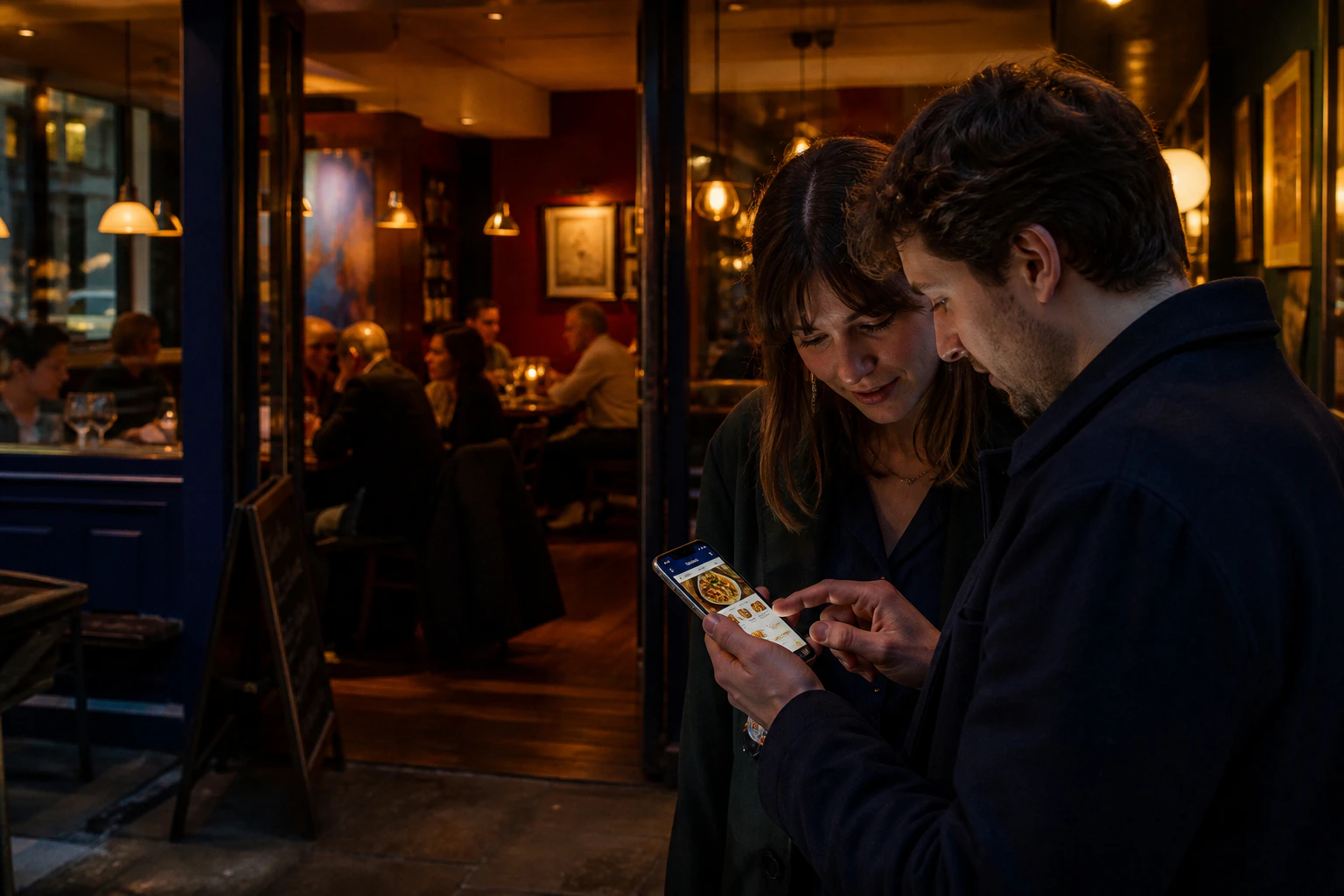
The best restaurant websites make a visit easier to imagine and organise. Food photography matters, but it is only one part of the decision. Guests also need the menu, price level, address, opening times, dietary context and a clear booking policy.
We reviewed live UK restaurant websites on 27 August 2026. Inclusion is not a judgement on the meal or private booking performance. Each site demonstrates a visible content or journey decision worth considering.
Related guidance: For useful context, read 15 Plumbing Website Examples That Make Enquiring Easy.
What the strongest restaurant sites have in common
the food and type of occasion are clear quickly;
menus work on mobile and show useful price context;
each venue has dependable practical information;
booking handovers preserve the chosen restaurant;
photography shows real food, people or place;
brand personality never hides the essentials.
Website | Useful pattern | Lesson to borrow |
|---|---|---|
Dishoom | Restaurant storytelling | Make atmosphere support practical choice |
Core by Clare Smyth | Tasting-menu clarity | Explain a special visit before reservation |
Silo London | Mission-led operation | Connect principles to the dining experience |
Brat | Restrained presentation | Let a focused proposition breathe |
Moor Hall | Destination planning | Include travel, stay and experience context |
Hawksmoor | Multi-location consistency | Give every venue dependable information |
THE PIG | Hotel and restaurant connection | Keep dining distinct within a wider stay |
Honest Burgers | Local venue pages | Join a shared brand to neighbourhood detail |
BAO | Distinct venue concepts | Help guests choose between related restaurants |
St. JOHN | Recognisable simplicity | Use a strong identity without decoration overload |
Blacklock | Menu and location clarity | Keep the practical route direct |
Ottolenghi | Several hospitality formats | Explain shops, delis and restaurants separately |
1. Dishoom: build a world without losing the booking
Dishoom uses detailed storytelling, illustration and venue personality. Each restaurant feels part of one brand, yet location information and reservations remain findable.
The lesson is not to write a fictional history for every dining room. It is to decide which story changes the guest's understanding, then keep menus, hours and booking outside the theatre when necessary.
2. Core by Clare Smyth: prepare guests for a special visit
Core by Clare Smyth presents a chef-led tasting experience with considered imagery and clear reservation prominence. A guest can understand that this is a planned occasion rather than a casual walk-in.
High-consideration restaurants should state menu format, indicative pricing, dietary approach, dress expectations and cancellation terms before checkout. Mystery should belong to the food, not the transaction.
3. Silo London: make principles operational
Silo London is known for a low-waste approach. The website connects that principle to ingredients, systems and the experience rather than leaving sustainability as a footer claim.
A mission becomes credible through decisions. Explain sourcing, reuse or community work with specific examples and dates. Avoid asking guests to accept a broad environmental label without evidence.
4. Brat: use restraint for a focused proposition
Brat lets its food, room and identity carry the presentation without turning the site into a feature catalogue.
Independent restaurants often benefit from fewer, stronger pages. Restraint works only when contact, menu and booking remain accessible. Minimalism should remove noise, not information.
5. Moor Hall: help visitors plan a destination
Moor Hall combines dining, setting and accommodation. The website therefore has to answer travel and stay questions alongside the menu.
Destination restaurants should provide arrival times, parking, accessibility and accommodation relationships. Cross-selling can feel helpful when it follows the guest's itinerary rather than interrupting it.
6. Hawksmoor: manage locations as one system
Hawksmoor operates restaurants in several cities. Venue pages carry local menus, hours, contact and booking while retaining a consistent brand.
Store practical details in one dependable source. A group site loses trust quickly when a global footer, booking platform and location page disagree about opening times.
7. THE PIG: give dining a place within a wider stay
THE PIG connects hotels, gardens, food and experiences. Restaurant content contributes to the destination without becoming indistinguishable from rooms and packages.
Hotels should give day diners and staying guests appropriate routes. Do not assume every restaurant visitor wants accommodation, and preserve the chosen property when moving into booking.
8. Honest Burgers: keep a growing group local
Honest Burgers has many locations but uses venue-specific information and local context within a recognisable system.
That is better than hundreds of identical place pages. Include what genuinely differs: hours, access, nearby landmarks, local specials and correct contact details.
9. BAO: distinguish related concepts
BAO operates several venues with different formats. The website helps guests understand that the same brand can offer more than one kind of visit.
When concepts differ, describe the meal, booking model and atmosphere explicitly. A single list of addresses leaves guests to discover important differences too late.
10. St. JOHN: let a confident identity stay functional
St. JOHN uses a highly recognisable, restrained identity. Its character comes from consistency rather than an accumulation of effects.
Smaller restaurants can learn from the discipline: choose a strong type and image system, then spend effort on accurate content. A memorable brand need not animate every interaction.
11. Blacklock: put menu, place and booking together
Blacklock makes the style of food and restaurants easy to grasp, with direct venue and booking routes.
A clear proposition reduces the amount of copy needed. Use the first section to answer what, where and why, then let menus and photographs provide detail.
12. Ottolenghi: explain several kinds of place
Ottolenghi spans delis, restaurants, shops and products. Location pages need to distinguish formats as well as addresses.
Businesses with several hospitality models should label the experience before showing availability. A visitor looking for table service should not discover after arrival that the selected location is primarily a deli.
A restaurant website checklist
Before launch, test whether a guest can:
find the correct menu without downloading it;
understand approximate price and format;
identify dietary and accessibility information;
choose the right venue;
complete or understand a booking on mobile;
find hours, address and telephone;
distinguish current information from an old event;
return from a third-party booking service without becoming lost.
What to avoid
Avoid a full-screen video that delays the menu, an unlabelled PDF, photographs of dishes no longer served and opening times copied into several conflicting places. Captions such as “original editorial image” add nothing for a diner; use a real description when context helps.
If a menu changes daily, state that and show a representative version with a date. Do not hide allergens or prices in order to preserve a clean design.
Want the website handled for you?
Elkwood builds managed websites for small businesses across the industries we support. Design, copy, hosting and reasonable changes are included from £25 a month, with booking or ordering services connected where suitable.
Read what is included and the restaurant template guide before choosing a route.
Sources checked
Food Standards Agency allergen guidance, checked 27 August 2026
The 12 linked restaurant websites, checked 27 August 2026
Quick answers
Frequently asked questions
What should a restaurant website include?
Include menus, prices, address, hours, contact, dietary and accessibility information, booking policy and real photography. Multi location groups need dependable venue pages.
Should restaurant menus be indexable HTML?
Yes, use an accessible HTML menu as the main version. A printable PDF can be offered additionally if it is also kept current.
How often should the site be updated?
Update operational details immediately. Review menus, events, booking terms and seasonal content whenever they change and check the full site at least quarterly.
Do restaurant websites need many pages?
No. One restaurant can use a compact structure if every practical decision is covered. Groups and destination venues usually need more distinct pages.