Strong plumbing website examples do more than display tidy bathrooms and a phone number. They help a worried customer act quickly, while giving somebody planning a boiler, heating system or refurbishment enough information to make a considered decision.
We reviewed live UK plumbing and heating websites to find patterns that other businesses can adapt. The examples are not ranked, and inclusion is not an endorsement of the company or its workmanship. We have assessed only what a visitor can see on the website, not private enquiry, ranking or conversion data.
Related guidance: For useful context, read Restaurant Website Templates: Six Useful Starting Directions and 12 Construction Websites That Prove Capability Clearly.
What the best plumbing websites have in common
The strongest sites make a few important decisions obvious:
whether the firm handles urgent repairs, planned projects or both;
which services it provides and which areas it covers;
how to call, message or request a quote from a mobile phone;
what qualifications, memberships or guarantees are relevant;
what completed work actually looks like;
what happens after somebody makes contact;
which claims are supported by reviews, case studies or named project details.
Website | Particularly useful pattern | Best suited to |
|---|---|---|
Plumb London | Clear appointment route and detailed case studies | Larger domestic and property portfolios |
Chaps Plumbing & Heating | Direct contact backed by real job evidence | Local owner-led businesses |
Novo Plumbing | Process, pricing context and service-area clarity | Higher-value planned projects |
GPM London | A simple three-step enquiry process | Mixed urgent and planned work |
The Red Van Plumbers | Detailed technical project evidence | Specialist heating and renewables work |
The table is a quick orientation, not a performance league. Every site and visible detail in this article was checked on 26 August 2026 and may change.
How we selected these examples
Each example had to demonstrate at least one useful, visible pattern. We considered service clarity, urgent versus planned journeys, geographic coverage, qualifications, reviews, project photography, contact usability and the amount of uncertainty removed before an enquiry.
We deliberately included different business models. An emergency plumber serving one city needs a different homepage from a mechanical contractor working on multi-floor commercial installations. A plumbing website template can provide a starting structure, but it should not force every firm into the same story.
1. Plumb London: make the appointment route unmistakable
Plumb London places booking and telephone options prominently, then supports the initial promise with services, coverage and a substantial case-study library. The case studies explain the property context and work carried out rather than relying on an unexplained gallery.
The transferable idea is to connect the contact route to evidence. A visitor can book quickly, but somebody who wants reassurance can inspect projects involving boiler replacements, heating conversions, wetrooms and property portfolios first.
The context matters. A larger London operation can justify a broader booking journey and deeper content library. A sole trader may be better served by a shorter form and a direct call or WhatsApp route.
2. Chaps Plumbing & Heating: make owner-led service feel tangible
Chaps Plumbing & Heating names the person behind the business, offers direct telephone and WhatsApp contact, explains its Sheffield-area coverage and uses real work throughout the site. The page also distinguishes selected emergency work from planned bathrooms, boilers, heating systems and higher-value projects.
This is useful because a local customer is often buying confidence in the person who will enter their home. Clear identity, direct contact and evidence of completed work make that promise more concrete than a generic claim about quality.
The lesson is not to place every possible reassurance above the fold. It is to lead with the few facts that reduce risk, then let reviews, photographs, case studies and FAQs provide depth.
3. Novo Plumbing: explain the buying process for planned work
Novo Plumbing is positioned around bathrooms, underfloor heating and boiler installation across Surrey, Berkshire and nearby areas. It gives indicative project times, explains its four-stage process and offers an estimator for people considering a bathroom project.
That is a strong fit for planned, higher-consideration work. The visitor is not necessarily looking for the fastest call-out. They may be trying to understand likely cost, disruption, responsibility and what happens after a consultation.
The transferable pattern is to answer process questions before the sales conversation. A useful plumber website can explain who surveys the job, when a written quotation appears, who manages other trades and how changes are handled.
4. GPM London: show the next three steps
GPM London’s plumbing and heating page uses a simple sequence: get in touch, arrange a survey or call-out, then complete the work. It also separates a repair or service from a planned installation and provides clear coverage across London, Kent and surrounding areas.
The useful element is not the number three. It is the reduction in uncertainty. Visitors know that the response depends on urgency and that a price should be discussed before work starts.
Any plumbing business can adapt this by describing its real process in plain English. Avoid inventing a polished five-step system if the actual experience is simply call, diagnose, quote and complete.
5. On Point Mechanical: let the project archive do the proving
On Point Mechanical organises a large project archive by type and provides project descriptions, locations and multiple photographs. The range covers domestic plumbing and heating alongside residential bathroom work and mechanical installations.
This demonstrates how a growing contractor can make a broad portfolio navigable. A project archive becomes more useful when a visitor can recognise work similar to their own, rather than scrolling through dozens of untitled images.
The caveat is maintenance. A filterable archive only helps if new projects are named, described and categorised consistently. Five strong case studies are better than fifty anonymous photographs.
6. Lacey Plumbing & Heating: explain commercial complexity
Lacey Plumbing & Heating uses detailed commercial case studies, including its Vitality office fit-out. The page identifies the project context, multiple floors, delivery partner, scope and changes made during the installation.
This is a useful model for commercial buyers because it shows how the contractor works inside a wider project team. Named responsibilities and variations tell a procurement or facilities reader more than a generic statement about being experienced.
The lesson for smaller firms is proportional evidence. A domestic case study might describe the original problem, the agreed solution, the time on site and the finished result. It does not need commercial-project language.
7. HF Group: align the page with the scale of the work
HF Group’s plumbing service presents water management, sanitary services and project experience across domestic, commercial and industrial environments. Recent projects include named sites and value bands, which help communicate scale.
That is appropriate for buyers who need evidence that a contractor can handle complex or high-value work. The site does not present a hospital or school project in the same way as a leaking tap.
The transferable principle is audience alignment. Use the language and proof your buyer needs. Domestic customers may value tidiness, communication and availability. Commercial buyers may need packages, compliance, sectors and delivery capacity.
8. The Red Van Plumbers: make technical expertise readable
The Red Van Plumbers combines broad plumbing and heating services with detailed specialist projects. Its underfloor heating case study includes the property context, area covered, number of zones, system design and components.
Specific detail makes the evidence credible without requiring the reader to understand every technical term. It also gives somebody planning similar work useful questions to ask any installer.
The caveat is readability. Technical depth should be layered beneath a plain-English summary so a homeowner can first understand the outcome, then inspect the specification if it matters to them.
9. Piping Hot Plumbing & Heating: define the service radius
Piping Hot Plumbing & Heating serves Haverhill and a defined radius across Suffolk and Cambridgeshire. Its areas page names towns while keeping the wider geographic promise understandable.
Clear coverage prevents wasted calls from outside the service area and reassures people searching locally. It is more helpful than adding dozens of near-identical location pages with little useful information.
Borrow the clarity, not the list length. State the base, normal radius and important towns. Create separate location pages only when there is genuinely useful local content to add.
10. Liberty Plumbing Solutions: own a specialist proposition
Liberty Plumbing Solutions focuses strongly on underfloor heating across Northamptonshire and nearby areas. Case studies and the geographic explanation support that specialist positioning.
This is a useful alternative to presenting every plumbing task with equal weight. If a service is particularly valuable, distinctive or well evidenced, the website can make it the primary proposition while still explaining related work.
Specialisation should remain honest. A focused homepage works when the enquiry handling, portfolio and team capability support it. Changing headings alone does not create expertise.
11. Lucas Plumbing & Heating: connect work samples to a quote
Lucas Plumbing & Heating provides service and area information, while its work page links examples back to a free quote and direct contact details.
The pattern is simple but valuable. Do not let a gallery become a dead end. After somebody sees a relevant bathroom or heating project, give them a clear route to discuss their own job.
The site could be adapted by adding short captions to every project. Location, challenge and type of work make an image more useful to customers and search engines than a filename or broad label.
12. Ealing Boiler Services: keep a narrow offer clear
Ealing Boiler Services centres on boiler installation, servicing and repair in Ealing and West London. It names its main areas, explains the first-visit approach and keeps telephone contact visible.
The narrow structure helps visitors self-select quickly. A boiler customer does not have to navigate a large bathroom, drainage and commercial portfolio to find the relevant route.
This is a reminder that the best plumbing websites are not always the largest. A focused service business can benefit from fewer, stronger pages covering the job, area, proof and next step.
13. LCD Heating & Gas Services: combine credentials with local proof
LCD Heating & Gas Services makes Clydebank, West Dunbartonshire and Glasgow coverage explicit. Its case-study section sits alongside Gas Safe and SNIPEF information, service routes and review evidence.
Qualifications become more useful when they appear in context. State what a registration relates to and provide the details a customer needs to verify it, rather than displaying a row of unexplained badges.
The limitation of any badge-led design is that visitors can become blind to logos. Pair credentials with named people, real jobs and a clear explanation of the work offered.
14. Heat in London: describe the engineering behind the result
Heat in London covers plumbing, heating and bathroom work, with case studies that explain the condition encountered, equipment selected and installation carried out.
This gives the work more substance than a finished-room photograph alone. Before-and-after context helps a potential customer understand the judgement involved, especially where heating, water pressure or system design affects the outcome.
The transferable idea is to document decisions as well as appearances. Ask the engineer for two or three plain-English notes after a notable job, then combine them with reviewed photographs.
15. Rheams Plumbing & Heating: separate common jobs from broader capability
Rheams Plumbing & Heating uses its case studies to cover common domestic work, such as combination boilers, alongside commercial assessment and heating projects.
The range shows that a case-study library can support more than one audience when each entry has a recognisable label and context. A homeowner can find the familiar boiler route while a commercial reader can inspect broader system experience.
The caveat is navigation. If audiences have different priorities, the main service pages and calls to action should still keep their journeys distinct.
Patterns worth borrowing
Across these plumbing website examples, the most useful ideas are structural rather than decorative.
Customer question | Website response | Evidence that helps |
|---|---|---|
Can you help now? | Separate urgent call-out route with visible availability | Clear phone action and honest response area |
Do you handle this job? | Plain service categories with focused detail pages | Relevant project or case study |
Do you cover my property? | Base, radius and meaningful area information | Local project, review or team detail |
Can I trust you? | Named people, relevant qualifications and explained process | Verifiable registration, reviews and real work |
What happens next? | Short enquiry and quotation sequence | Response expectations and contact choices |
Can you handle a larger project? | Sector, scope and delivery information | Named case studies with responsibilities |
Separate urgent work from planned work
An emergency visitor wants a number, coverage and realistic availability. Somebody planning a bathroom wants examples, process, approximate timing and a quote route. One homepage can serve both, but it should not make them follow the same path.
Make mobile contact genuinely easy
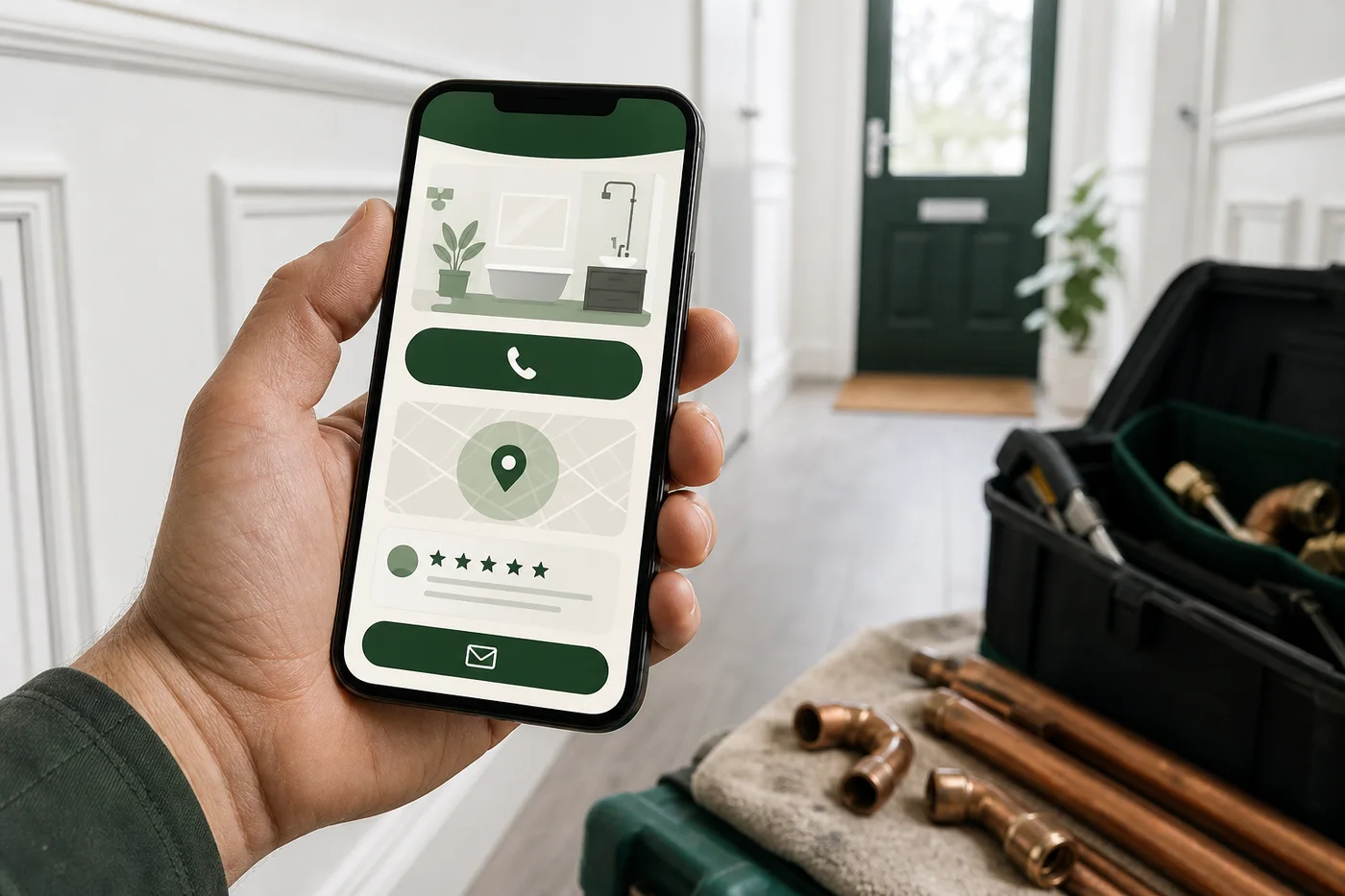
A click-to-call button should use a real telephone link, remain readable and avoid being covered by chat widgets or cookie controls. Forms need appropriately sized fields, useful labels and only the information required at that stage.
Use project evidence with context
Add a location broad enough to protect customer privacy, the original need, the work completed and the result. If a figure or technical detail is sensitive, leave it out. The goal is to help readers understand capability, not expose a customer.
Explain trust signals
Use current, relevant registrations and link to verification where appropriate. Do not imply that one credential covers work outside its scope. Reviews are stronger when their source and date are visible.
Plumber website checklist
Before choosing a design or plumber website template, check that the finished site can answer these points:
[ ] The homepage states the main services and core area clearly.
[ ] Urgent and planned enquiries have distinct routes.
[ ] Telephone and message actions work on mobile.
[ ] Service pages explain what is and is not included.
[ ] Areas are described without thin, duplicated town pages.
[ ] Qualifications are current, relevant and verifiable.
[ ] Reviews identify their source.
[ ] Real projects have captions or short case studies.
[ ] The contact form asks only for useful information.
[ ] Opening hours and emergency availability are accurate.
[ ] Every page has a clear next step.
[ ] Somebody is responsible for updates, security and hosting.
What not to copy
Do not copy another plumber’s brand, wording, photography or claims. Besides the legal and ethical problems, imitation makes it harder to explain why a customer should choose your business.
Avoid copying a feature simply because it looks impressive. A quotation calculator needs reliable rules and ongoing maintenance. A large project filter needs enough well-described work. An emergency banner is misleading if nobody can answer the phone outside normal hours.
Use the examples to identify the questions your own customers ask, then answer those questions with your own evidence and operating reality.
Want the website handled for you?
Elkwood builds fully managed websites for plumbers with the copy, hosting, SSL, domain and ongoing amendments included. The service starts from £25 per month, with no need to assemble a template, manage plugins or become your own website administrator. You can also see the pricing and what is included before deciding whether it fits.
The businesses featured above are independent examples and are not presented as Elkwood clients.
Quick answers
Frequently asked questions
What should a plumber website include?
At minimum, include clear services, areas covered, relevant qualifications, direct contact details, opening or emergency availability, an enquiry route and evidence of real work. Planned services also benefit from a process explanation, FAQs and case studies.
What makes a good plumber website?
A good site helps the right visitor decide whether the business fits their job and makes the next step easy. Clarity, genuine proof, mobile usability and accurate availability matter more than fashionable effects.
How much does a plumber website cost?
The price depends on whether you buy a template, commission a one off build or use a managed service. Compare the complete cost, including copy, imagery, hosting, security, maintenance and future changes. Elkwood’s managed option starts from £25 per month.
Should I use a template or have the site built for me?
A template can work if you have time to adapt the structure, write the copy, source imagery and maintain the technical setup. A managed build is usually more suitable when you want the website tailored and maintained without handling those tasks yourself.